

Best Startup Marketing Ads: 16 Polarizing Examples
Updated: Jul 22

As startup marketers we can’t please everyone. We can’t really believe that everyone will want to buy our product.
So why do we treat our marketing like this is a possibility? Why do we create messaging that speaks to everybody yet touches no one?
Imagine it the way you’d answer the classic "Do you prefer cats or dogs?” question. You're bound to lose the affection of one side of the pet aisle in your admiration for the other.
That’s reality. That’s honesty. That’s really, really good for marketing.
Keep reading for 16 polarizing startup ads.
16 polarizing ads from the world's hottest startups.
1. Heura

As a plant-based meat brand in Barcelona, Heura is led by startup marketers who get their audience.
In what's still the revolutionary years of this category, Heura consumers tend to be early-adopters who identify as vegan, or sustainably-conscious. This demographic tends to be very anti-traditional. Those who likely aren't praying in the pews.
Playing it safe in fear of Catholic backlash just doesn't benefit the brand. The marketing succeeds because of its ability to push cultural hot buttons.
In fact, Heura epitomizes what this article is all about: The willingness to sacrifice one audience in service of another (The Do You Prefer Cats or Dogs Principle).
2. Meela

When I first saw this ad from Meela, I thought it was for a new dating app. But it got me to stop my scroll and that’s what really matters.
Meela's actually a digital matchmaking service who pairs people with licensed therapists. Their ad works to address the big question patients face: 'Will I be able to find a therapist who doesn't judge me?'
Showing up for this underserved audience, their startup marketers apply what I call "The Elephant in The Room Principle." This principle states that startup brands create standout by advancing the conversation on hot or traditionally taboo topics.
"Find someone who doesn't see your cheating history as a red flag," says the ad. It's almost the perfect line by Meela.
3. Riley

This question really shouldn't be polarizing.
But as the 21st century workplace continues to fail at meeting the needs of its women, this ad succeeds by calling out the establishment's incompetence.
What makes Riley's ad so great is how their question demonstrates immediate proof of concept. Everyone (in their right mind) agrees that it's absurd for any workplace to ask their employees to bring in their own toilet paper.
After all, it's a basic human need. So why should workplaces ask women to bring in their own tampons? Riley's comparative framing helps the audience say "Yeah... this doesn't make sense, Boss."
4. Graza

"This olive oil ad isn't polarizing," you say!
But contrary to assumption, polarization in marketing isn't about telling your audience who you voted for in the political primaries. It's about getting people to make a decision about you.
And in this example, if Graza, the popular olive oil brand, made the switch from plastic to glass bottles, they were probably hearing it from their audience about this flawed packaging choice. Whether that be for sustainability reasons, or the preference that any high-quality olive oil should always come in glass—only Graza knows for sure.
But whether we care to admit, there's a greater statement within the words "Now in glass."
5. Oura

This "Give us the finger" ad by OURA is an example of The You Talkin' To Me Principle.
This principle's inspired by the 1978 Hollywood film, Taxi Driver (Robert DeNiro).
You take a famous pop culture one-liner and reframe it in a way that's relevant to the product. Since the audience already has associated memories with said one-liner, your messaging is hacking memorability.
As a smart ring tracking health and wellness data, OURA's ad really says: 'Give us your finger so you can live healthier.'
6. Whiny Baby

Yes, you are.
Whiny Baby is a made-for Gen Z wine brand shattering 13,000 years of wine drinking tradition.
This question, "Are We Trolling The Wine Industry?!?!," was shared by founder, Jessica Druey, across social. It was a PR-savvy slapback to a San Francisco wine critic who had written how Whiny Baby, in all its unconventional glory—seemed to be "trolling the wine industry."
And since Whiny Baby positions against traditional wine's lack of accessibility, it was the perfect opportunity to double-down.
7. Bloom and Wild

Use your creative concepts to attack stereotypes that exist in your industry. That's the lesson you can take from Bloom and Wild's "No Red Roses" Valentine's Day campaign.
Drawing from their Care Wildly brand platform, they also shared a letter with customers explaining how the "cliché of buying someone roses" went against their "Thoughtful Marketing" values.
From a startup marketer's perspective, Care Wildly does what future market leader's are expected to do. The messaging zags from traditional product norms, applying what I call The Rebel With a Cause Principle.
It states that:
"The success of every startup marketing program, lies in its ability to position against the status quo of a traditional product category."
8. Taimi

"Being hot isn’t all about looks, it’s about how you love," says Taimi.
As a dating app for LGBTQ+, for Taimi to become a leader in this marketplace, starting with their progressive beliefs is important.
This is another example of The Elephant In The Room principle. Taimi's advert uses its copy to call out the toxic culture overtaking modern dating apps.
From a design strategy, what makes this ad extraordinary is its decision to lean into the "hot model" stereotype. It makes for great juxtaposition, which the best ads have.
9. Light Phone

Light Phone is trying to steal business from Apple.
They want you to think of them as the 'smart phone alternative.' In fact, one Light Phone marketing ad positioned it as the "dumb phone."
Their belief is that smart phone tech has surpassed human progress. It's now controlling people's lives. *Light Phone's ambitious marketing strategy focuses on calling out the biggest player in the smart phone movement: Tim Cook, the CEO of Apple.
Finally, the gutsy creative choice to go with graphic sketch type helps this ad stand out among the everyday industry standard.
*Check out more from these talent startup marketers in my article - Great Hompages: 20 Startup Brand Examples.
10. Otta

"Otta," now "Welcome to the Jungle," is the recruitment company of "transparency."
Roll your eyes if you've heard that one before. But you've never seen one of those traditional recruitment agencies run an ad like this.
By calling this out (The Elephant In The Room Principle), Otta positioned their tech recruiting agency as the status quo alternative.
The original post by then founder, Sam Franklin, went viral on LinkedIn.
11. Hertility

Hertility is pioneering the reproductive revolution. As a women's healthy company, they specialize in home hormone & fertility testing.
When it comes to ovary health, most of us (of sound mind), understand the many misguided stigmas within the manosphere that are damaging to women.
To create a polarizing position against, Hertility coined the phrase, "You're not ovary-acting."
It's an extraordinary play on words. The one-liner uses a bit of that You Talkin' To Me Principle where they turn a cultural phrase on its head, reframing it in a way that's relevant to Hertility.
This is a great ad to save in your startup marketer's library.
12. Surreal

There's an old wise tale that John Harvey Kellogg created Kellogg's corn flakes as part of a remedy to stop masturbation. As a Seventh-Day Adventist (a culty, ruin-your-childhood kind of religious group), the idea was that bland foods with no sugar suppressed indulgence.
Including... masturbation.
Is this really true? Nobody knows. But the legend lives on because it's more compelling that chatting about the boring nothingness that is corn flakes.
So, Surreal made a polarizing ad about it.
Good for them.
13: DASH Water

How do you feel about a polycule? You know, a sharing a romantic relationship with several different partners at the same time?
DASH Water, a London-based sparkling water has always seen the world a bit differently. They're famous for using wonky fruit in their product. The fruit that tends to get thrown out before reaching the supermarket because it looks disfigured.
So it was only natural that DASH made a sparkling water ad about the benefits of a polycule relationship.
"Have your cake and drink it," says the subway print ad. "The drink that has it all." It's reference to their product RTBs: "No calories. No sweeteners. Tastes phenomenal."
Who's down for a polycule?
14: friend

"friend," is an actual AI Startup friend.
(Yipee)
You know a concept is polarizing when its ad has been vandalized even more than a middle school bathroom.
At this marketing moment, the world is just the perfect-kind-of-crazy to bring this baby to market. After all, reports tell us.... hell.... forget "reports." Common sense tells us that our world is lonelier than it's ever been in modern history.
"someone who listens, responds, and supports you," says the ad.
Some people say they have friends who struggle to do that sometimes. But that's why I always go for the dog.
15: Nucleus Genomics

Wooooooooooooooooooooooooooooooooooooooooooooooh, baby. Where to begin with this one?
Nucleus Genomics has officially entered the real-life utopian dream world: Brave New World. 1984. The Giver. It's all happening in 2026. Really, truly, madly, deeply.
But even though this is a hard pass?
It's a great ad.
16: Artisan
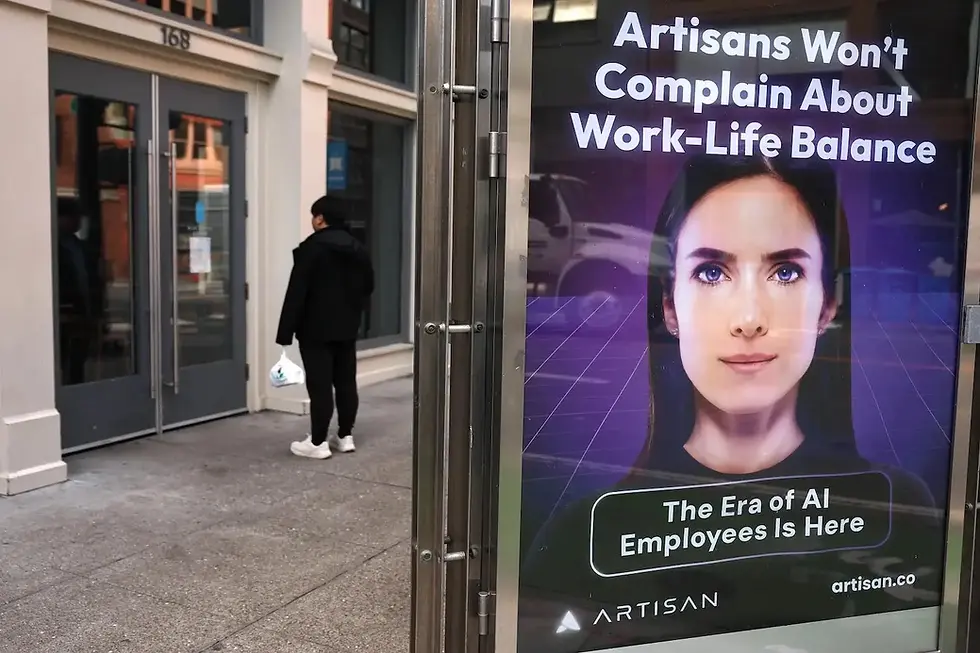
Another version of this campaign ad said "Stop hiring humans."
Artisan took high heat. Rightfully, so. But instead of bashing them which the rest of the internet has already done. Let's see it from their side.
With a product like AI Agents, marketing momentum exists within the early-adopter audience. Specifically, those companies who are ready for AI to not only maximize humans in the workplace—but replace them altogether.
From a business perspective, Artisan doesn't need to care about upsetting the masses. They just need to get the attention of a few renegade CEOs.
Artisan has since doubled-down, publishing a blog about the story behind the "Stop Hiring Humans" campaign. While this was no doubt a manufactured marketing moment, it gave them more attention than they ever dreamed.
You just need to ask yourself, "If we do this... will our prospects be waiting for us on the other side?"
Congratulations.
In a world of squirrel-like attention span, you've made it to the end.
Thanks for reading.
Don't be a stranger. Or... I'll find you.

Don't hate my Stupid For Startup content?
Connect with me personally on — My LinkedIn.


