

Your Startup Marketing Strategy Needs Comparative Ads (12 examples)
- Dec 3, 2025
- 10 min read

Hey startup founder, marketer, rebel-with-a-cause. It's just you and the dealer. Mano a mano.
Push those chips forward like you're Lady Luck about to hit it big on the Vegas strip. Porterhouse. Lobster tails. 30-year-old scotch. The world is yours. Glitz. Glamour. Grandeur visions of the proverbial gambler.
Of course, this is just hedonic allegory.
But if only winning marketing were as simple as having chips in the game. If only you could put your head down, play your hand, and forget everyone else at the table.
If only it was you, your product, and your strategy.
If only it were that easy.
Positioning against the competition
The biggest losers are not those who overestimate themselves. But those who, whether by accident, arrogance, or lack of self-awareness, underestimate everyone else.
Perhaps creativity is to blame. This idea that creative marketers must start from scratch on a blank piece of paper to create something that can live and breathe on its own. After all, creativity is an individual creation. Right?
But how useful is creative marketing that's detached from what people already know? Or better yet, what consumers are already familiar with in the marketplace?
How smart is it to make people work harder to comprehend these individual concepts? Or ask them to add meaning where there is none?
It's this creative thinking that inspires marketing departments to play the marketing game as if they're the only player at the table.
As if their ambition is the only ambition.
The Chip and a Chair: Who Cares Principle

There's a famous poker saying, "All you need is a chip and a chair."
It means that every player at the table, even those with just one chip, has a chance to win the pot. It's the quintessential, pat-yourself-on-the-back-for-being-a-participant philosophy.
This sounds great if you were playing a poker game against yourself. But only in Disney movies can you neglect the competition and still win the state championship with Zac Efron playing point guard and singing a cappella.
Startup marketing isn't some imaginary world where your traits and features go unchallenged by the competition. In fact, success is defined less by your attributes, and more by the players competing around you.
Just like sitting down to a poker table, you wouldn't write a brand campaign without making an effort to understand what hands your competitors are playing. No, you'd plan your strategy accordingly.
The Chip and a Chair: Who Cares Principle is defined by an external approach to marketing: This ability to build a program of assets, awareness, and advertising that positions against a competitor's strategy.
For example.
If you were a new startup soft drink. That means taking a look at what Big Soda brands saying and doing in the market before you even utter a word. That means creating product packaging that distinguishes your branding from 100 years of tired tradition.
Becoming the alternative
When you're honest about what stands in your way. When you respect your competitors, you take away their competitive advantage.
If you can adopt this marketing mindset, you'll find yourself engaged in marketplace battles that play to your strength.
This the art of the "alternative." You're not looking to be better than the original. You're not trying to out-do the traditional brands at their own game in their own category. You want to be different. You want to stand out for underserved audiences: Those progressive consumers being left behind by outdated products not suited for the modern age.
If you can position against the products of yesteryear. If you can use progressive messaging to highlight the weaknesses of competitors in today's marketplace.
You stand a chance.
Creating comparative ads
Whether you're beginning your early-stage startup marketing. Or feel that you're mid-stage startup marketing has plateaued.
Comparative ads are a great way to start anew.
But first. What is a comparative ad exactly? As defined in the The Chip and a Chair: Who Cares Principle — Comparative advertising is pretty much calling out your competitors by name and telling the world your product is the *superior choice.
*At least for that underserved audience you're trying to reach.
The Brave New World Principle
A successful comparative ad comes down to your ability to showcase the old world versus the new.
At Stupid For Startups, I call this The Brave New World Principle. The best startup marketing clearly defines the status quo of the industry. Then gives the consumer a glance into a new world of possibility.
"Come with us into this progressive, healthier way of living and being," says the best startup comparative ads. "We've found a better way."
Futuristic features
Transformational benefits
Unorthodox ingredients
Progressive values
These marketing differentiators are what bring The Brave New World Principle to life. Everything you need to make a standout comparative ad.
Now, let's cut this chitter-chatter. And review 12 startup comparative ad examples.
12 startup comparative ads
1. Olipop

Olipop's brand position is A new kind of soda.™ With an ambition that bold, they're going to need to position against the competition. Those giants of industry, the Coca-Cola's of the world, that have given soda a bad name.
However, in order to eat into in the sales of their competitors, they'll need to prove their goodness.
Olipop uses this comparative product graphic on its online product pages: including Amazon. It gives new-age consumers the chance to see the breakdown between the old world versus the new: traditional soda versus A new kind of soda.™ (The Brave New World Principle)
With prebiotics being the crux of what differentiates Olipop from the sugary staples of yesteryear, the visual proof is stunning when you consider the drop from 46g of sugar per can in traditional soda down to 2-5g in Olipop. Not to mention, zero grams of fiber compared to 9g of fiber in their original good-gut formula.
This Olipop example is one of my all-time favorites.
As you look to grow with comparative advertising, it would be a great exercise if your startup marketing department used this as a template.
2. Airwallex

Most importantly, this comparative ad removes the Airwallex buying barrier: Big Banks.
But first, context.
Airwallex is a very fast-growing global payments platform. They allow a business to receive local and international payments from customers through any number of payment methods.
With their biggest competitors being the big banks, this takes us back to The Chip and a Chair: Who Cares Principle. Airwallex's marketing can't rely simply on product features to distinguish themselves as the best global payments platform.
They must develop marketing that directly positions against their competitors.
"You don't need a bank to run your business," says Airwallex.
This one-liner addresses the perception in the mind of their prospects. That a big bank, naturally, would be the way forward for global payments. Once Airwallex reframes this misperception in their prospect's mind, they help to reposition the competition in the marketplace.
After seeing this ad, more people walk away with the understanding that a big bank may not be the best option for global payments. This isn't a buy now message for Airwallex. Simply, just the first step in the marketing funnel and creating brand awareness.
3. Back Market

I love my Apple products. But nevertheless, it's always a joy when someone takes on such a Goliath.
Back Market is a second-hand device market. They're challenging the modern-day consumer and our unhealthy obsession with ‘new.’
This Back Market ad is a direct callout of everything Apple stands for. A company built on creating, launching, and quickly outdating their new iPhone models with even newer iPhone models. All for profit.
"Join the refurb revolution," replies Back Market.
This line not only positions against Apple's 'new' identity. But the Back Market copywriters make it sound just like Apple: the alliteration, and the need to turn every product into a tired tech movement. It's Back Market using their own medicine against them in the name of something much more good and sustainable for the planet.
Something that Apple claims to be good for. But can never prove.
Back Market for the win.
4. Light Phone

Well. Apple is taking a beating.
Light Phone, who, rather than refurbishing iPhones like Back Market, makes the world's anti-smartphone. The magic in their memorable marketing messaging comes from an old repositioning trick.
They turn Apple's strength into a weakness.
"Dumb is good," says Light Phone.
"Less features, more life."
Meanwhile, 'smart' is repositioned to mean the opposite. Something that robs us of life. The doom-scrolling, too-much-technology-to-handle kind of product that's gone too far.
From a creative concepting perspective, juxtaposition makes this ad successful. Since people would never associate "dumb" with meaning "good," that's when you make the alternative argument.
If you pull off juxtaposition like this Light Phone ad, you'll create better standout in your startup marketing.
I promise.
5. Heura

Startup marketing works best when it can demystify the status quo. Today, there's no startup doing this better than Heura.
As a plant-based meat startup, they take comparative advertising to a whole new level. Especially on social media. A place where the brand finds many progressive eaters who are always eager to share their content within their networks.
Heura's marketing team is savvy at coming up with creative concepts that successfully dramatize the downfall of meat. This pig example above, which they've also done for chicken, is really brilliant.
We've all heard whispers about how the sizes of pigs have grown over the years. But, when you see it visually laid out like this you can't help but question the role of conglomerate meat companies and their lack of conscious with regards to what their serving the public.
By positioning as the 21st century solution as it contrasts the old, Heura is applying The Brave New World Principle.
6. Policygenius

Policygenius isn't running a comparative ad against one competitor. They're positioning against an entire industry.
As an online insurance marketplace, Policygenius helps everyday people compare quotes and buy policies without the complexity of an everyday insurance company.
In a really traditional industry, they're the progressive middle-man between seller and buyer. The difference between confusion and understanding.
"Simple," is probably the one word, one feeling, one benefit you'd use to best describe this ad. And in a category like insurance, that's a good feeling for a prospect to walk away with.
7. DASH Water

DASH Water has become a major disruptor in the soft drink category. They like to take risks. And when it comes to comparative advertising, they go right for the jugular of the world's biggest soft drink brand.
After all, why play it small?
"No sugar. No sweeteners. No worries," says DASH Water.
"Finally, a drink to feel good about."
All you have to do is read their tagline. And you can feel a century's worth of sugary disappointment evaporating before your eyes.
If you want to follow a brand who refuses to toe the line. Who will give you some inspiration to reach a little further down into the marketing well. Following DASH Water on social media is a good place to start.
8. Who Gives A Crap

Who Gives A Crap isn't just the brand name. It's the big question in the world of toilet paper. And someones gotta answer it.
You wouldn't typically associate toilet paper with innovation. Butt there's a first for everything.
Positioning against every competitor in their industry, Who Gives A Crap is highly differentiated toilet paper that refuses to cut down trees. They're made out 100% recycled material. Mostly bamboo.
Aside from reducing deforestation, they also donate 50% of their profits to clean water and sanitation nonprofits across the world.
What makes their marketing messaging so memorable is their humorous touch. It's this sort of play on words that's at the heart of the Who Gives A Crap brand messaging strategy.
"Uncrap the world," says the ad.
"The planet needs us, no ifs or ands. All butts."
An important lesson here, is that when you double-down on such a traditionally sterile industry, part of what makes it work is continuing to bring that world to life in new and colorful ways, and always pushing the creative as far as you can.
9. Huntress

I had the chance to write for Huntress cybersecurity last summer. They're a super innovative brand in this category. And their marketing messaging is a great example of a startup brand finding an underserved audience to champion.
"Cybersecurity for All," says Huntress. "Not Just the 1%."
This is a love letter for every business in the world who ever wanted "enterprise-grade" security but couldn't have it because of "crushing complexity or bank-breaking price tag."
In a world of IBM's and Crowdstrike's and Palo Alto Networks'—Huntress is the hero for those left behind.
Their mission puts it best, 'security isn't a privilege, it's something everyone deserves.'
10. allplants

'Ready meals,' or what we used to call 'microwave dinners' are accompanied by a giant elephant.
I call this.... wait for it... The Elephant in The Room Principle. The definition is as follows:
"Standout in startup COMMS & marketing improves by calling out controversial taboos in a given industry—and forwarding the conversation in a way that's relevant to the product."
Allplants is an example of how to apply this principle successfully. They know that consumers are aware of the fact that 'ready meals' contain ingredients you can't pronounce: aka chemicals.
By addressing these fears head-on, and using a memorable message to differentiate their product, "100% plants. 0% rubbish," Allplants can begin building awareness against these barriers in the minds of their buyers.
11. Whiny Baby

Whiny Baby is a made-for Gen Z wine brand.
Positioning against a 13,000-year-old industry, founder Jessica Druey is on a mission to bring accessibility to the wine industry.
"A reimagined wine experience!" says the Whiny Baby headline.
The exclamation point is enough to get yourself excommunicated from traditional wine branding. Not to mention the images of dressed-down Gen Z-ers, bottle caps instead of corks (so naughty), and all the anti-traditional wine drinking vibes.
All in all, this Whiny Baby comparative ad is a great example of the The Rebel With a Cause Principle.
It states that:
"The success of every startup marketing program, lies in its ability to position against the status quo of a traditional product category."
12. ClickUp
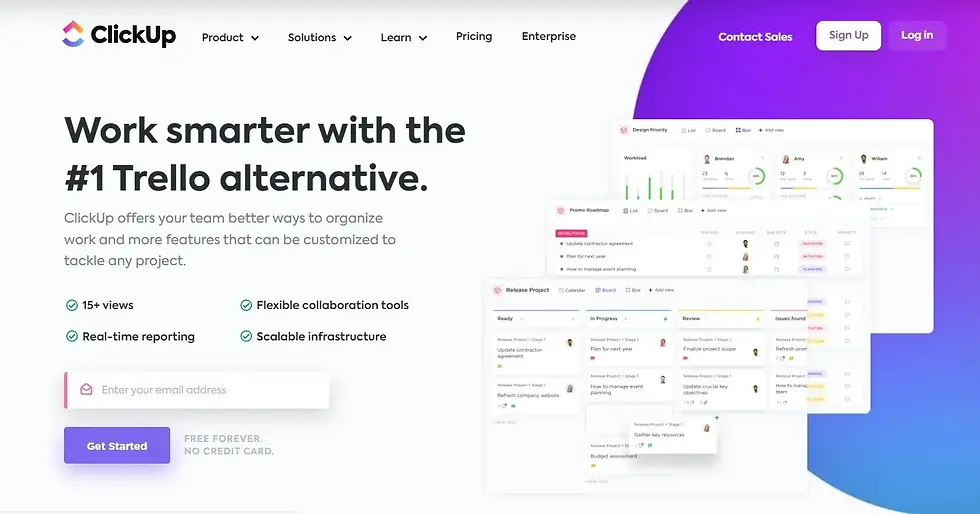
ClickUp's marketing has no business being as good as it is.
As a project management platform, they're in a crowded marketplace. But it's their self-awareness and savviness to turn this into a customer acquisition strategy that makes this ClickUp landing page memorable marketing.
If you know who your number one competitor is, it's logical to assume that there's going to be customer runoff. Trello is a big name in this space. For ClickUp to talk so candidly to these prospects is the way every dissatisfied wants to be seen and heard.
"Work smarter with the #1 Trello alternative," says the headline.
That's a great introduction.
BONUS: Stupid For Startups Favorite
🐐
Comparative ads disclaimer:

I follow Jack Scott on LinkedIn. He's the Co-founder and CMO of DASH Water.
Jack shared this image last week in a post with these words:
"I searched 'DASH' on Ocado (Online Grocery Market) last week… Got served an ad for Diet Coke and Coke Zero. I didn’t expect to see that sandwiched between our cans."
The moral of the story? No matter how you feel about comparative advertising. Our competitors, those giants of the marketplace, will continue to search for the competitive advantage.
Let's keep this top of mind.

Want more Stupid For Startup content?
Connect with me personally on — My LinkedIn.


